Algae are seen as the ideal biofuel source. They feed on CO2 from the surrounding air and grow using the photosynthesis route. They can be stored and processed as biofuel.
One of the benefits to harnessing algae is that it can use waste-water and ocean water, and it is relatively harmless to the local environment should it spill or leak. Algae also have a much higher production rate per acre than soy or corn.
Some studies have shown that up to 99% of the CO2 introduced to the solution can be converted or sequestered. However, algae populations can bloom and grow so quickly that they outrun the supply of nutrients or sunlight, leading to a collapse of the population. The cost of production in terms of water and energy input is also high. Carbon emissions have also been shown to be high.
New techniques have been working around these problem areas, but more is to be done. A new study in Energy and Fuels shows that when you grow that algae in bioreactors made up of clear tubes, so much energy is required that the carbon footprint of the biofuel is over three times greater than the fossil fuel it would replace.
According to Anna Stephenson from the University of Cambridge, when algae is grown in clear-tubed bioreactors the energy required to move the algae around so that it gets enough sunlight means that per megajoule equivalent of fuel, the algae fuel has a carbon footprint of 320 grams while petro-diesel takes 86 grams. Stephenson notes that when in grown in open ponds, however, the carbon footprint drops markedly, becoming 4.5 times lower than petro-diesel. However open ponds utilise more water! And the yield of biofuel from open ponds is much low than from reactors.
Just when algae seemed to be the intelligent way to use sunlight, absorb carbon dioxide and make fuel! Not to be discouraged, some way will be worked out. That's what technology and research is all about.
Saturday, July 31, 2010


Desertec on track
The deserts of Africa to generate power for Europe? - exactly what the Desertec project set out to accomplish in 10 years and now it looks, five years.
This is based around a series of huge concentrating thermal plants in the Sahara Desert and elsewhere around North Africa and the Middle East, with transmission lines bringing the power north into Europe. The figures have been impressive : by 2050, the projects are capable of generating up to 470,000 megawatts of electricity; only 0.02 percent of the land area in the region will be needed for all of the solar plants; in fact, only one percent of the entire world's desert area, if covered by solar power plants, could power, well, everything.
Tall order?? What about transmission losses across large distances? The power loss over high-voltage direct-current transmission lines is about 4 to 5 percent per 1,000kilometers of transmission; the costs associated with such losses, however, are made up by the remarkably high insolation (solar radiation energy) in the North Africa region, according to Desertec.
Costa are high and yes, the area is politically unstable, but given the target of achieving 20 percent of its power from renewables, Europe is squaring its shoulders.
The first pilot project around Morocco and surrounding cities may well take off soon.
This is based around a series of huge concentrating thermal plants in the Sahara Desert and elsewhere around North Africa and the Middle East, with transmission lines bringing the power north into Europe. The figures have been impressive : by 2050, the projects are capable of generating up to 470,000 megawatts of electricity; only 0.02 percent of the land area in the region will be needed for all of the solar plants; in fact, only one percent of the entire world's desert area, if covered by solar power plants, could power, well, everything.
Tall order?? What about transmission losses across large distances? The power loss over high-voltage direct-current transmission lines is about 4 to 5 percent per 1,000kilometers of transmission; the costs associated with such losses, however, are made up by the remarkably high insolation (solar radiation energy) in the North Africa region, according to Desertec.
Costa are high and yes, the area is politically unstable, but given the target of achieving 20 percent of its power from renewables, Europe is squaring its shoulders.
The first pilot project around Morocco and surrounding cities may well take off soon.
Thursday, July 29, 2010
Plug the soot
More grist for the mill - soot is inching close to carbon dioxide as a major contributer to global warming. And where does most of soot come from? - burning biomass in the developing nations, (which still do not have other means).
According to a new study by Stanford researcher Mark Z. Jacobson, if we were to cut soot emissions we could drastically halt the melting ice in the Arctic. His study showed that soot is second only to carbon dioxide in contributing to global warming; putting it above other greenhouse gasses like methane. Additionally Jacobson found that soot kills over 1.5 million people prematurely each year and affects millions more with respiratory illness, cardiovascular disease, and asthma. (that has been well known fact.)
Jacobson found that while fossil fuel soot contributed more to global warming, the soot emitted from biofuels caused eight times the number of deaths as fossil fuel soot did. By providing electricity to rural and developing areas, the need to burn biofuels to cook and heat would drop, and possibly so too the health impacts.
Reducing soot emissions would have an immediate impact on global warming due to the magnitude with which soot is playing a part in our atmosphere, and the way in which it plays. Soot is washed out of the atmosphere within a few weeks, compared to gases that sometimes stay for decades or a century. So it is best to address this problem which we can by replacing biomass with electricity in the villages of developing nations.
Controlling the carbon emissions from all the polluting industries, power plants and vehicles has proven to be a slow and difficult task. How easier will it be to lighten million homes with electricity, and cut the soot?
According to a new study by Stanford researcher Mark Z. Jacobson, if we were to cut soot emissions we could drastically halt the melting ice in the Arctic. His study showed that soot is second only to carbon dioxide in contributing to global warming; putting it above other greenhouse gasses like methane. Additionally Jacobson found that soot kills over 1.5 million people prematurely each year and affects millions more with respiratory illness, cardiovascular disease, and asthma. (that has been well known fact.)
Jacobson found that while fossil fuel soot contributed more to global warming, the soot emitted from biofuels caused eight times the number of deaths as fossil fuel soot did. By providing electricity to rural and developing areas, the need to burn biofuels to cook and heat would drop, and possibly so too the health impacts.
Reducing soot emissions would have an immediate impact on global warming due to the magnitude with which soot is playing a part in our atmosphere, and the way in which it plays. Soot is washed out of the atmosphere within a few weeks, compared to gases that sometimes stay for decades or a century. So it is best to address this problem which we can by replacing biomass with electricity in the villages of developing nations.
Controlling the carbon emissions from all the polluting industries, power plants and vehicles has proven to be a slow and difficult task. How easier will it be to lighten million homes with electricity, and cut the soot?
Wednesday, July 28, 2010
Green is healthy
Some things are well known by instinct. Yet when research backs what we already know, we feel good about it, right? So, now that yet another study tells us that forests and other natural, green settings can reduce stress, improve moods, reduce anger and aggressiveness and increase overall happiness, we agree.
Forest visits may also strengthen our immune system by increasing the activity and number of natural killer cells that destroy cancer cells, says a study by Finnish Forest Research Institute, Metla.
Many studies show that after stressful or concentration-demanding situations, people recover faster and better in natural environments than in urban settings. Blood pressure, heart rate, muscle tension and the level of "stress hormones" all decrease faster in natural settings. Depression, anger and aggressiveness are reduced in green environments and ADHD symptoms in children reduce when they play in green settings.
Preserving green areas and trees in cities is very important to help people recover from stress, maintain health and cure diseases. There is also monetary value in improving people's working ability and reducing health care costs, as one of the team says.
But in the final reckoning, trees in cities are giving way to wider and wider roads to facilitate more vehicles. We seem to be wantonly destroying that which is beneficial to our health.
Forest visits may also strengthen our immune system by increasing the activity and number of natural killer cells that destroy cancer cells, says a study by Finnish Forest Research Institute, Metla.
Many studies show that after stressful or concentration-demanding situations, people recover faster and better in natural environments than in urban settings. Blood pressure, heart rate, muscle tension and the level of "stress hormones" all decrease faster in natural settings. Depression, anger and aggressiveness are reduced in green environments and ADHD symptoms in children reduce when they play in green settings.
Preserving green areas and trees in cities is very important to help people recover from stress, maintain health and cure diseases. There is also monetary value in improving people's working ability and reducing health care costs, as one of the team says.
But in the final reckoning, trees in cities are giving way to wider and wider roads to facilitate more vehicles. We seem to be wantonly destroying that which is beneficial to our health.
Tuesday, July 27, 2010
Solar advances
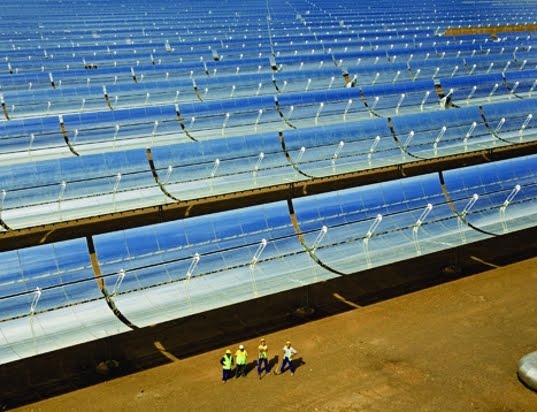
Sicily has just announced the opening of the world’s first concentrated solar power (CSP) facility that uses molten salt as a heat collection medium. Since molten salt is able to reach very high temperatures (over 1000 degrees Fahrenheit) and can hold more heat than the synthetic oil used in other CSP plants, the plant is able to continue to produce electricity even after the sun has gone down.
While photovoltaic solar panels work by directly producing electricity from sunlight, CSP plants use mirrors to concentrate sunlight and produce high temperatures in order to drive a turbine to generate electricity. CSP plants have been in existence for many years, but the Archimede plant is the first instance of a facility that uses molten salt as the collection medium.
Some existing CSP plants have used molten salt storage in order to extend their operation, but the collectors have relied on oil as the heat collection medium. This has necessitated two heat transfer systems (one for oil-to-molten-salt, and the other for molten-salt-to-steam) which increases the complexity and decreases the efficiency of the system.
The Archimede plant has a capacity of 5 megawatts with a field of 30,000 square meters of mirrors and more than 3 miles of heat collecting piping for the molten salt. The cost for this initial plant was around 60 million Euros.
Cost is one thing, the other being maintenance of the wide-spread unit. Huge tracts of land are required for CSP units plus, the use of salt could lead to some problems in cleaning when the salt freezes. Still, CSP could be the technology for desert or waste lands? How would it compare with biofuels used on the same land? Any comparisons?
The U.S. Senate Energy Committee meanwhile advanced a big piece of solar energy legislation recently. This bill is aimed at getting 10 million new solar systems on U.S. roofs in the next 10 years. The U.S. Department of Energy claims that combined with existing solar energy incentives, the 10 Million Solar Roofs bill could exceed its goal of 10 million new solar systems in 10 years.
Hold on to sewage
What is scarce? - Energy, power. What is abundant? - Waste. And if you can convert the abundant into the scarce, what joy!
Engineers at Oregon State University have made a significant advance toward producing electricity from sewage, by the use of new coatings on the anodes of microbial electrochemical cells that increased the electricity production about 20 times.
The findings, just published online in Biosensors and Bioelectronics, a professional journal, bring the researchers one step closer to technology that could clean biowaste at the same time it produces useful levels of electricity -- a promising new innovation in wastewater treatment and renewable energy.
Engineers found that by coating graphite anodes with a nanoparticle layer of gold, the production of electricity increased 20 times. Coatings with palladium produced an increase, but not nearly as much. And the researchers believe nanoparticle coatings of iron -- which would be a lot cheaper than gold -- could produce electricity increases similar to that of gold, for at least some types of bacteria.
In this technology, bacteria from biowaste such as sewage are placed in an anode chamber, where they form a biofilm, consume nutrients and grow, in the process releasing electrons. Sewage is the fuel for electricity production.
The treatment of wastewater could be changed from an energy-consuming technology into one that produces usable energy. The technology already works on a laboratory basis, researchers say, but advances are necessary to lower its cost, improve efficiency and electrical output, and identify the lowest cost materials that can be used.
Now this is what makes more sense than trying to discover new sources of energy, right?
Engineers at Oregon State University have made a significant advance toward producing electricity from sewage, by the use of new coatings on the anodes of microbial electrochemical cells that increased the electricity production about 20 times.
The findings, just published online in Biosensors and Bioelectronics, a professional journal, bring the researchers one step closer to technology that could clean biowaste at the same time it produces useful levels of electricity -- a promising new innovation in wastewater treatment and renewable energy.
Engineers found that by coating graphite anodes with a nanoparticle layer of gold, the production of electricity increased 20 times. Coatings with palladium produced an increase, but not nearly as much. And the researchers believe nanoparticle coatings of iron -- which would be a lot cheaper than gold -- could produce electricity increases similar to that of gold, for at least some types of bacteria.
In this technology, bacteria from biowaste such as sewage are placed in an anode chamber, where they form a biofilm, consume nutrients and grow, in the process releasing electrons. Sewage is the fuel for electricity production.
The treatment of wastewater could be changed from an energy-consuming technology into one that produces usable energy. The technology already works on a laboratory basis, researchers say, but advances are necessary to lower its cost, improve efficiency and electrical output, and identify the lowest cost materials that can be used.
Now this is what makes more sense than trying to discover new sources of energy, right?
Friday, July 23, 2010
Renewable gas
National Grid, which distributes gas and electricity in northeastern US and the UK, says that renewable gas could meet 16% of demand.
Published in a white paper, Renewable Gas - Vision for a Sustainable Gas Network, the company research shows how biomethane produced from waste could meet the needs of its US customers in Massachusetts, New York, Rhode Island and New Hampshire. With investment of around $7 billion across the four states it covers, National Grid says renewable gas could meet up to 25% of demand and reduce greenhouse gas emissions by around 16 million tons a year.
Unconventional sources such as dairy farms, waste water treatment plants, landfills, wood waste and food waste plants will get linked into the grid. In fact, any unit that generates biodegradable waste can be a potential source. An excellent way to get rid fo colossal waste we generate too.
In the UK, National Grid has joined forces with British Gas and a local brewer, Adnams, to use waste from the brewing process to produce biomethane and inject it directly into the UK’s gas network. The remaining waste is an effective manure material.
Published in a white paper, Renewable Gas - Vision for a Sustainable Gas Network, the company research shows how biomethane produced from waste could meet the needs of its US customers in Massachusetts, New York, Rhode Island and New Hampshire. With investment of around $7 billion across the four states it covers, National Grid says renewable gas could meet up to 25% of demand and reduce greenhouse gas emissions by around 16 million tons a year.
Unconventional sources such as dairy farms, waste water treatment plants, landfills, wood waste and food waste plants will get linked into the grid. In fact, any unit that generates biodegradable waste can be a potential source. An excellent way to get rid fo colossal waste we generate too.
In the UK, National Grid has joined forces with British Gas and a local brewer, Adnams, to use waste from the brewing process to produce biomethane and inject it directly into the UK’s gas network. The remaining waste is an effective manure material.
Subscribe to:
Posts (Atom)

 Posts
Posts

