Showing posts with label CSP. Show all posts

Wednesday, January 9, 2013

Muscle to CSP

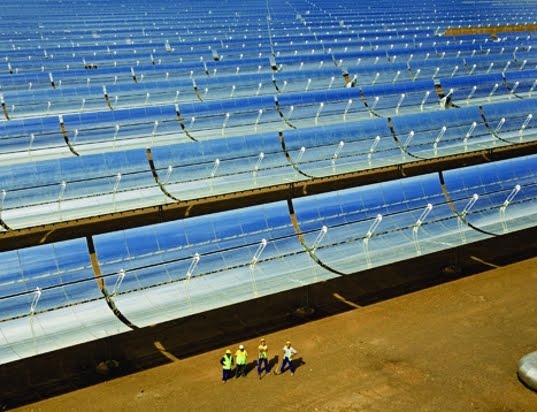
The storage capacity of concentrating solar power (CSP) can add significant value to a utility company's optimal mix of energy sources, a new report by the U.S. Department of Energy's National Renewable Energy Laboratory (NREL) suggests.
The report found that CSP with a six-hour storage capacity can lower peak net loads when the sun isn't shining, enough to add $35.80 per megawatt hour to the capacity and operational value of the utility, compared to photovoltaic (PV) solar power alone, and even higher extra value when compared to CSP without storage.
The net load is the normal load minus variable renewables such as photovoltaic and wind. The additional value comes because thermal storage allows CSP to displace more expensive gas-fired generation during peak loads, rather than displacing lower-priced coal; and because it can continue to flatten the peak load in the evenings when PV isn't contributing to the mix because the sun has set.
The report, "Simulating the Value of Concentrating Solar Power with Thermal Energy Storage (TES) in a Production Cost Model,"  noted that the $35.80 per megawatt extra value would come in a scenario in which there is relatively high penetration of renewables into the utility's mix, about 34 percent. If the penetration was lower, the extra value would be lessened.
CSP with TES, with an ability to store thermal energy in, say, molten salt, can use its heat-energy to drive turbines at power plants over much longer stretches of the day. Compared to other renewable options, at high penetration levels CSP with TES can be dispatched to displace natural gas rather than coal. This is important because electricity produced from natural gas fired generators is typically more costly than that produced from coal.

Tuesday, August 23, 2011

CSP in India: mixed prospect

Is CSP a good option for India? Maps from NASA and Meteonorm show a range of approximately 1800-2200 kWh/m2/year for DNI across India, an annual DNI resource comparable to the best European sites such as Spain, though lower than the best sites in the USA and Australia. The northwest of India is widely recognised as having the best sites in the country. Jodhpur, on the edge of the Thar desert, is almost exactly comparable on an annual average basis to Granada, one of the best Spanish sites.

However, the Indian Renewable Energy Status Report notes that there is no established capability in India for CSP manufacture and there is a gap in Engineering, Procurement and Construction capability for setting up and running CSP plants. In examining the barriers to technology transfer for renewable energy technologies for India, the report identifies: product suitability to Indian conditions, difficulty in accessing market information for foreign companies, limitations in infrastructure availability, and difficulty of financing.

Published cost estimates for India vary by a factor of nearly 80 percent from lowest to highest. High current costs are an immediate barrier. Prior to the closing of the Solar Mission's phase 1 applications in December 2010, potential developers suggested that the Solar Mission CSP tariff was not sufficient. The fact that the Request for Selection was oversubscribed and that the shortlist of developers offered discounts on the tariff ranging from around Rs.3 to 5 off the Rs.15.3/kWh cap would suggest that some developers believe that cost is not an insurmountable barrier.

The World Bank's analysis of CSP costs versus the Solar Mission phase 1 tariff cap concluded that with either tower or trough technology and either wet or dry cooling, projects would not be viable even under the maximum allowed tariff. If this is the case, then cost remains a large barrier to CSP in India. On a positive note, a range of financial and regulatory incentives were analysed and it was concluded that all measures taken together were sufficient to make projects viable.

Wednesday, August 3, 2011

CSP promises

Sometimes problems have simple solutions that do not need new rocket science tech! It is simply about assemblage and simplification of known elements.

Researchers at MIT are designing a new method of building concentrating solar power plants with thermal storage that they say could lower the cost of energy by 50% compared with existing technologies. MIT Mechanical Engineering Professor Alexander Slocum – along with a group of other researchers – says he’s designed a new type of tank for molten salt storage that could reduce equipment needs, increase durability and ultimately reduce the cost of electricity being generated by a plant.

Rather than use a complicated plumbing infrastructure to heat and pump the molten salt for storage, Slocum’s design puts the salt storage and water heating in a single tank mounted on the ground, rather than on a tower far above the field of mirrors. Under the new design, the mirrors are actually mounted on a hillside above the storage tank and reflect sunlight down into a small opening in the top.

Not only does the design ensure minimum parts but is also more durable as it avoids extreme swings in temperature on the system (to avoid which systems are usually oversized).

The use of storage like molten salt will be key to the success of the industry, experts say. To make real progress with deploying these technologies, you need to have the dispatchable characteristics like firm power. CSP is different from PV and can provide power at twilight, so to say!

Saturday, July 31, 2010

Desertec on track

The deserts of Africa to generate power for Europe? - exactly what the Desertec project set out to accomplish in 10 years and now it looks, five years.

This is based around a series of huge concentrating thermal plants in the Sahara Desert and elsewhere around North Africa and the Middle East, with transmission lines bringing the power north into Europe. The figures have been impressive : by 2050, the projects are capable of generating up to 470,000 megawatts of electricity; only 0.02 percent of the land area in the region will be needed for all of the solar plants; in fact, only one percent of the entire world's desert area, if covered by solar power plants, could power, well, everything.

Tall order?? What about transmission losses across large distances? The power loss over high-voltage direct-current transmission lines is about 4 to 5 percent per 1,000kilometers of transmission; the costs associated with such losses, however, are made up by the remarkably high insolation (solar radiation energy) in the North Africa region, according to Desertec.

Costa are high and yes, the area is politically unstable, but given the target of achieving 20 percent of its power from renewables, Europe is squaring its shoulders.

The first pilot project around Morocco and surrounding cities may well take off soon.

Tuesday, July 27, 2010

Solar advances


Sicily has just announced the opening of the world’s first concentrated solar power (CSP) facility that uses molten salt as a heat collection medium. Since molten salt is able to reach very high temperatures (over 1000 degrees Fahrenheit) and can hold more heat than the synthetic oil used in other CSP plants, the plant is able to continue to produce electricity even after the sun has gone down.

While photovoltaic solar panels work by directly producing electricity from sunlight, CSP plants use mirrors to concentrate sunlight and produce high temperatures in order to drive a turbine to generate electricity. CSP plants have been in existence for many years, but the Archimede plant is the first instance of a facility that uses molten salt as the collection medium.

Some existing CSP plants have used molten salt storage in order to extend their operation, but the collectors have relied on oil as the heat collection medium. This has necessitated two heat transfer systems (one for oil-to-molten-salt, and the other for molten-salt-to-steam) which increases the complexity and decreases the efficiency of the system.

The Archimede plant has a capacity of 5 megawatts with a field of 30,000 square meters of mirrors and more than 3 miles of heat collecting piping for the molten salt. The cost for this initial plant was around 60 million Euros.

Cost is one thing, the other being maintenance of the wide-spread unit. Huge tracts of land are required for CSP units plus, the use of salt could lead to some problems in cleaning when the salt freezes. Still, CSP could be the technology for desert or waste lands? How would it compare with biofuels used on the same land? Any comparisons?

The U.S. Senate Energy Committee meanwhile advanced a big piece of solar energy legislation recently. This bill is aimed at getting 10 million new solar systems on U.S. roofs in the next 10 years. The U.S. Department of Energy claims that combined with existing solar energy incentives, the 10 Million Solar Roofs bill could exceed its goal of 10 million new solar systems in 10 years.

Friday, November 28, 2008

They do it with mirrors!


To paraphrase from one of Agatha Christie's books, 'they do it with mirrors'. Not murder foul, but power clean!
Much of the argument against solar energy is about its costs and storage. But emerging from the shadow of PVs is a technology that avoids the common problems.

In the Andalucian desert of southern Spain, more than 1,000 mirrors, each about half the size of a tennis court, and with a collecting area of 120 sq km, are being carefully positioned. In January, when switched on the plant will start generating 20 MW of electricity. The power will be enough for 11,000 Spanish homes.

Part of the world's biggest solar tower plant, this uses the simple technology of reflecting sunlight to superheat water at a 160 metre high central tower. Here the concentrated light heats water to more than 260C, producing steam that can turn a turbine and generate electricity.

When switched on, the new plant will be the world's largest commercial CSP plant feeding electricity into a national grid.

This solar tower is part of a 300 MW solar farm which will supply power for 700,000 homes by 2013. It will include solar trough collectors and PVs.

The costs are high, double that of conventional power generation but as the project becomes larger, costs are expected to come down. In Spain, the feed-in tariff assures investors of a return for the power generated and fed into the grid.

Regarding the storage, solar thermal has an advantage over PVs as the excess heat can be stored in the form of molten salt from which the heat can be obtained when required. Almost 8 hours of solar energy can be stored by 28,000 tonnes of salt heated to 220 deg C.

In a country like India which recieves plentiful sunlight, CSP is a good option. But besides the parabolic trough system used to cook food, not much has been done. Why for instance can’t be vast expenses of Rajasthan’s deserts be used? Of course, water availability is a criteria but new technologies use air to cool the system. Maintenance is a bit intensive but labour should be no problem here.

Is there a clause for tax exemptions, subsidies only for proven technologies as in the US? Why haven’t entrepreneurs taken CSP here? Why can’t we adopt the feed-in tariff system?

Any answers?